
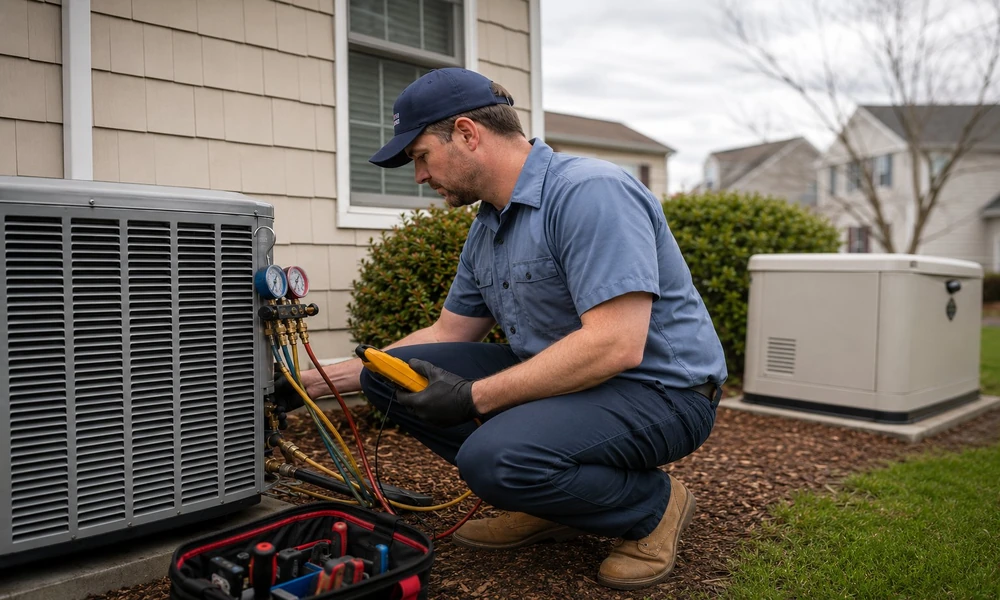

Shopping for a new air conditioner or heat pump used to come down to size, efficiency, and price. Now there’s a fourth question hiding behind the sales pitch: what refrigerant does it use? Over the past two years the rules changed, the equipment changed, and the internet filled up with confusing claims, including that your current system is about to be banned. It isn’t. The whole story fits into a handful of numbers, so here they are, one at a time.
2,088: the number that started it
Most home air conditioners and heat pumps installed over the past couple of decades use a refrigerant called R-410A. Refrigerants are rated by global warming potential, or GWP, which compares how much heat a gas traps in the atmosphere against carbon dioxide. R-410A has a GWP of roughly 2,088. That means a small leak has an outsized effect on the climate compared with the same amount of CO2.
700: the new ceiling
In 2020, Congress passed the American Innovation and Manufacturing Act, which directed the EPA to phase down a family of refrigerants called HFCs. The EPA’s Technology Transitions rule, finalized in 2023, then set a GWP limit of 700 for new residential and light commercial air conditioning and heat pump systems. R-410A is far above that line, so it can’t be used in new systems built after the cutoff.
Here’s the part that gets lost in the headlines. According to the EPA’s frequent questions on the HFC phasedown, the 2023 rule does not limit the use of any existing product or system, and you can continue to repair your existing residential air conditioning or heat pump system. Nobody is coming for your working equipment.
January 1, 2025: when factories changed course
That was the date manufacturers could no longer produce or import new residential split systems that use refrigerants above the 700 limit. The original rule also set January 1, 2026 as the last day to install older systems from leftover stock. In May 2026, though, the EPA finalized a revision that removed that installation deadline for systems whose components were made or imported before January 1, 2025. In practice, installers can keep putting in older R-410A equipment until the remaining inventory runs out, while every newly built system uses a different refrigerant.
So anyone researching hvac installation in Saline, or anywhere else, will probably see both kinds of equipment quoted for a while: leftover R-410A units and new systems. Ask your installer which one is on the estimate, and whether any of the components were manufactured after the cutoff. The answer affects what you can expect for servicing, parts, and resale down the road. You can read more at hvac installation in Saline.
466 and 675: the new refrigerants
The two main replacements are R-454B, with a GWP around 466, and R-32, with a GWP around 675. Both fall under the 700 limit. They belong to a class called A2L, which means lower toxicity and mildly flammable. Mildly flammable sounds alarming, but it’s a classification, not a warning label for your living room. Equipment is designed, tested, and installed with those properties in mind, and the safety features and installation practices are built around them.
What it does mean is that the equipment is not interchangeable. An outdoor unit built for the new refrigerant generally needs a matching indoor coil and compatible components. You can’t simply swap the gas in an old system.
Zero: the repairs you must skip
None. If your current R-410A system works, keep it. If it needs a repair, the EPA’s position is that repairs are allowed. Refrigerant for servicing existing systems will remain available during the phasedown, though prices may rise as supplies tighten. A refrigerant change alone is not a reason to replace a healthy system. Age, repair history, efficiency, and comfort are better reasons.
Three: the questions to ask your installer
When you do replace, a few direct questions cut through the noise.
First, which refrigerant does this system use, and when were its major components manufactured? Second, are the indoor and outdoor parts a matched set, and is the whole system covered by the warranty? Third, are your technicians trained and certified to handle this refrigerant, and does the installation include the proper leak checks, line work, and commissioning steps?
Any technician who handles refrigerant should hold EPA certification, and an installer comfortable with A2L equipment will be able to explain the safety practices without hedging. Get the answers in writing, along with the model numbers.
One: the number to remember
Of everything above, one fact matters most for a homeowner: the rules govern new equipment, not the equipment you already own. The practical takeaway is simple. If your system is running well, you have no deadline. If it’s failing, compare quotes on equal terms, ask which refrigerant each one uses, and make the choice based on the whole package of efficiency, warranty, installation quality, and price.
The refrigerant transition will keep working its way through the market for years, and the details will keep shifting. The questions won’t. Ask what’s being installed, ask who is installing it, and ask for it in writing. That’s enough to cut through almost every confusing claim.




Leave a Comment